Prog Metal Underground

Your home for progressive metal — events, new album drops, gear reviews, and guitar mastery. From Dream Theater to Periphery, Meshuggah to H...
New York City, US
Created byProfile pictureMahir Oberai
9 joined
Profile picture
Mahir OberaiProfile picture@mahiro·Jul 2

Djent Had a Boom and a Crash. Post-Metal Never Did. Here's Why That Matters.

Two subgenres emerged from roughly the same lineage — Meshuggah on one side, Neurosis/ISIS on the other — and took completely different paths through the last two decades. One had a hype cycle, a backlash, and a diffusion into "just a production technique." The other just... kept building, slowly, without ever going viral, and is arguably healthier right now than it's ever been.


Worth understanding why.


---


Djent's Arc Was Fast and Violent


2007 to 2011: Meshuggah's rhythmic vocabulary gets codified by Periphery, TesseracT, and Skyharbor into something teachable and imitable. The term "djent" itself — onomatopoeia for a palm-muted, high-gain guitar chug — starts as an in-joke on a Meshuggah forum and becomes a genre label within a few years.


2012 to 2016: peak hype. Bedroom producers everywhere are learning the technique because it's learnable — 8-string guitar, specific palm-mute rhythm, a handful of scale patterns, and you're most of the way to a passable djent riff. YouTube explodes with "djent" tag videos. It becomes a meme, an aesthetic, a punchline.


2017 to 2020: backlash and fatigue. "Djent is dead" thinkpieces everywhere. The genre gets accused — correctly, in a lot of cases — of being technique without songwriting. The flood of low-effort imitators using the same palm-mute pattern over the same 8-string tuning drowns out the bands doing something interesting with the vocabulary.


2021 onward: diffusion. Djent stops being a genre and becomes an ingredient — a rhythmic technique absorbed into metalcore, prog metal, even pop-adjacent production. We covered this exact pattern in the post-djent diaspora piece a couple weeks back. The word itself becomes almost embarrassing to use unironically.


That's a complete hype cycle: emergence, peak, backlash, diffusion. About fifteen years, start to finish.


---


Post-Metal Never Had That Cycle


Cult of Luna formed in 1998. Isis (RIP, but the lineage runs straight through everything that followed) were doing crescendo-based, atmosphere-first heavy music at the same time Meshuggah was codifying the rhythmic complexity that became djent's ancestor.


Post-metal never had a viral moment. There was no meme, no internet in-joke that became a genre name, no explosion of bedroom imitators flooding the space. It just kept getting made, album after album, by bands who were mostly building on their own earlier work rather than reacting to a scene.


And in 2026, Cult of Luna is playing Mariner in full at ArcTanGent — a headlining slot, 28 years into the band's existence, for an album that's nearly a decade old. That's not nostalgia programming. That's a band whose audience has grown with them rather than moved on from them. The Ocean's Solaris — a nearly 70-minute Tarkovsky-inspired concept record — is getting serious critical respect in 2026 rather than being dismissed as bloated or self-indulgent. Try releasing something that ambitious and that long in a genre that had a hype-crash cycle and see how it's received.


---


Why the Difference Actually Exists


Djent was defined by a technique: a specific palm-mute rhythm, a specific guitar tuning, a specific gain structure. Techniques are learnable in a weekend, imitable at scale, and therefore susceptible to flooding. When thousands of bedroom producers can replicate the surface signifiers of a genre without understanding what made the originators interesting, you get a supply glut. Supply gluts create backlash. Backlash creates hype-cycle collapse.


Post-metal is defined by a structural and emotional sensibility — long-form dynamic build, patience, the specific feeling of a crescendo that's been earned rather than rushed. That's not something you can shortcut. You can't fake twenty minutes of patient tension resolving into a genuinely cathartic peak by copying a riff pattern. The skill ceiling for doing post-metal badly but recognizably is much higher than the skill ceiling for doing djent badly but recognizably. That naturally limits the flood of low-effort imitators, which means the genre never accumulated the same backlash pressure.


---


The Lesson for Every Subgenre After This


Genres built around a repeatable technical signature move fast and die fast — or at least flame out and get absorbed. Genres built around a harder-to-copy aesthetic sensibility age slowly and keep their credibility.


This isn't a moral judgment on djent, which produced genuinely great records during its run and left a permanent mark on the genre's rhythmic vocabulary. It's just an observation about durability. If you're trying to guess which corner of prog metal will still be filling rooms in fifteen years, bet on the bands whose sound can't be reverse-engineered from a YouTube tutorial in an afternoon.


Post-metal made that bet by accident, just by being what it always was. It's paying off now.

Profile picture
Mahir OberaiProfile picture@mahiro·Jul 1

Spotify Is a Terrible Way to Discover Prog Metal. Here's What Actually Works.

If you're relying on Spotify's algorithm to surface new prog metal, you're going to be listening to the same forty bands for the rest of your life.


That's not hyperbole. The platform's recommendation engine is tuned for 3-minute songs, high skip rates on anything with a long intro, and completion metrics that punish 12-minute tracks with ambient intros. Prog metal is structurally incompatible with the signals Spotify uses to decide what to surface next. The "Prog Metal" editorial playlist updates slowly and leans on established names. Release Radar catches new releases from bands you already follow — it doesn't introduce you to anything.


So where does discovery actually happen in 2026? Genuinely asking — and also answering.


---


The YouTube Rabbit Hole Is Still the Best Entry Point


For new listeners coming from outside the genre, YouTube remains the most reliable funnel. Here's why: the algorithm there rewards watch time and completion rate. A 10-minute playthrough video that holds attention gets surfaced. That's the opposite of Spotify's skip-penalty logic.


The chains look like this:


The heavy path: Metallica → Tool → Meshuggah → Periphery → Animals as Leaders. Each link clicks naturally enough that the algorithm follows you there. By the time you've watched three AAL playthrough videos you're getting recommended Haken and TesseracT without asking for them.


The atmospheric path: Radiohead → Porcupine Tree → Opeth → TesseracT → Leprous. This is the path that tends to produce the listeners who end up caring most about composition and dynamics rather than just heaviness.


The melodic path: Muse → Biffy Clyro → Haken → Plini. Different entry texture entirely — less metal-adjacent at the start, more about melody and arrangement sophistication.


The riff path: Pantera → Mastodon → Gojira → The Ocean. The listener arrives at post-metal and prog metal from below, through heaviness, and ends up somewhere they didn't expect.


The gateway chain matters because it shapes what you hear when you get deep. Someone who entered through Opeth arrives at Leprous hearing completely different things than someone who entered through Periphery.


---


Rate Your Music and Album of the Year Are Underrated


For a specific type of listener — the kind who thinks about music analytically and likes ranking things — RateYourMusic and Album of the Year are genuinely excellent discovery tools.


Both sites aggregate ratings in ways that surface consensus across a community of people who care. Cryptic Shift's Overspace & Supertime sitting at the top of the prog metal charts on AOTY right now is a meaningful signal: it's not an algorithm deciding that, it's a community of invested listeners rating it against everything else. That's a different and more reliable filter.


The risk with both platforms is the echo chamber of very online taste — they over-index on critically acclaimed and under-index on purely enjoyable. But for finding the records that serious listeners consider essential in a given year, they're considerably better than anything Spotify surfaces.


---


Bandcamp Solves a Problem Spotify Doesn't Know It Has


The long tail of prog metal — smaller labels, self-released records, international bands who don't have Spotify editorial relationships — lives on Bandcamp.


The genre tag system there is imperfect but functional. If you go deep on a Pelagic Records or Kscope page, their "you might also like" connections are actually curated relationships rather than algorithmic ones. Labels on Bandcamp function as taste-filters: if you trust Pelagic's signing decisions (and you should), their catalog is a pre-curated discovery path.


The Bandcamp Friday purchase culture also creates community signal. What people are buying, what's getting recommended in purchase activity, what shows up in fan collections — these are real human signals rather than engagement-optimized ones.


---


Reddit and Discord Are the Actual Infrastructure


r/progmetal does something no algorithm can: it applies community taste in real time. The "where do I start" threads generate genuinely useful entry points because humans with context are answering them. The recommendation chains that emerge from good-faith discussion are better than anything recommendation engines produce because they're contextual — the recommender knows what the asker already likes.


Discord servers built around specific labels, bands, or scenes function similarly at smaller scale. The signal-to-noise is higher when the community is smaller and more invested.


---


The Discovery Problem That's Actually Getting Worse


Here's the uncomfortable truth about 2026: there are more good prog metal records being released than at any point in the genre's history. Bandcamp has democratized production. Smaller bands in Norway, Australia, South America, and Southeast Asia are making records that would have been structurally inaccessible to a global audience ten years ago.


And most of the genre's own audience isn't finding them. The curation infrastructure hasn't scaled with the release volume. The labels can only sign so many bands. The editorial playlists move slowly. The algorithms are structurally hostile.


This is why community curation — forums, Discord, trusted individual recommenders — matters more in 2026 than it did in 2016. The algorithmic middle layer has failed the genre. The human layer is holding.


Find your people. They have better playlists than Spotify does.

Profile picture
Mahir OberaiProfile picture@mahiro·Jun 30

Why Prog Metal Rhythms Feel Like the Floor Is Moving (And the Drummers Who Make That Happen)

New prog metal listeners always describe the same experience: something sounds slightly wrong, like the beat is in the wrong place, like they've lost count — and then it snaps back, and it felt intentional all along. They don't have a word for what just happened.


The word is metric modulation. And once you hear it, you can't unhear it anywhere in this genre.


---


What Metric Modulation Actually Is


Metric modulation is when the pulse of the music shifts. A subdivision that was running underneath the main beat suddenly becomes the main beat. The tempo feels like it changed — sometimes it actually did, proportionally — but the relationship between old and new pulse is mathematically locked.


The simplest example: imagine a steady quarter-note pulse. Triplets start appearing in the drum fill. Those triplets are at a specific rate. Now imagine the music lands on a new section where that triplet rate is the new quarter note. The tempo shifted, but it didn't just jump randomly — it pivoted on a subdivision that was already present in the music.


That's the mechanism. What changes in the hands of great drummers is how disguised that pivot is, how long the listener floats in the transitional space before the new ground appears under their feet.


---


The Tracks to Hear It In


Tool — "Lateralus" (2001)

Danny Carey's approach throughout this album is essentially a masterclass in making metric displacement feel inevitable rather than confusing. The famous 9-8-7 Fibonacci structure in the verses is well-documented, but what's less talked about is how his fills function as announcements of the modulation — you can hear him preparing the new ground before the song lands on it. He signals before he arrives.


Animals as Leaders — "CAFO" (2009)

The opening is in 9/8. The riff then moves in a way that implies 4/4 against the 9, creating a polymetric feel where the downbeats of the riff and the downbeats of the meter don't align until they suddenly do. Garstka (and Navene Koperweis on the original) is holding two timelines simultaneously — the notated meter and the implied accent structure of the guitar. This is where "two drummers" jokes come from and they're not entirely wrong.


Haken — "The Architect" (2016)

Raymond Hearne's drumming on Affinity navigates metric modulations that the band embeds in their compositional structure. The bridge section of "The Architect" in particular modulates in a way that's almost cinematic — you feel the shift in weight before you consciously register the meter changed. It's compositional metric modulation rather than improvisational, written into the arrangement rather than executed in real time.


Meshuggah — essentially everything

Meshuggah's approach is technically polymetric rather than metric modulation — the drum kit generally stays in 4/4 while the guitar riffs operate in patterns that don't align with it, creating a slow-moving collision pattern where the downbeats of guitar and drums align every N bars. Tomas Haake is the anchor holding the 4/4 grid while the riffs float around it. This is the inverse of what most people expect: the drummer is the most normal element in the arrangement, and that's precisely what makes it work.


---


Why This Is Hard (And Why Most Drummers Don't Do It)


The technical challenge of metric modulation isn't executing the new meter — it's internalizing the transition without losing tempo in the gap between old and new pulse.


Most drummers, even technically skilled ones, have a moment of latency during a metric modulation where they're calculating rather than playing. That latency shows. It's usually just a few milliseconds of rhythmic hesitation, an almost imperceptible grip on the fill, but listeners feel it as uncertainty even if they can't name it.


The players who execute this seamlessly — Carey, Garstka, Gavin Harrison, Raymond Hearne — have internalized the relationships between note values so deeply that the calculation is invisible. They're not doing math at the kit. They've done the math enough times that it became physical.


That level of internalization requires years of deliberate practice specifically on transitions, not meters. Most drumming education teaches meters in isolation. Metric modulation lives in the between-space, and that's what nobody's teaching.


---


The Listener's Side of This


Here's something worth considering: prog metal audiences have developed significant rhythmic literacy through repeated exposure to this stuff. Listeners who've spent years with Tool, Meshuggah, and AAL have unconsciously internalized metric modulation as a language — they feel the resolution of a modulation as satisfying in the same way a harmonic resolution is satisfying.


That's unusual. Most popular music never asks this of its audience. The fact that prog metal does, and that there are millions of people who find it more satisfying as a result, is one of the more interesting things about the genre's culture.


The floor moves. The best drummers make sure you land somewhere good when it does.

Profile picture
Mahir OberaiProfile picture@mahiro·Jun 29

The Prog Metal Drum Kit Isn't Just Drums Anymore. The Hybrid Era Is the New Normal.

There's a version of this conversation that gets derailed immediately by the "is it real drumming" crowd. We're not doing that. The hybrid drum kit has been standard practice in serious prog metal for long enough that the authenticity debate is just nostalgia in disguise.


What's actually interesting is what the hybrid era enables — and why the best drummers in the genre have been ahead of this curve for years.


---


What a Hybrid Kit Actually Is (and Isn't)


A hybrid setup is an acoustic drum kit with electronic elements integrated into it — trigger pads, Roland SPD-SX sample pads, MIDI controllers, sometimes electronic cymbals mixed with acoustic ones. The drummer plays a real kit but can simultaneously trigger samples, loops, atmospheric layers, and sounds that don't exist in the acoustic world.


This is distinct from trigger reinforcement, which is almost universal in professional prog metal live rigs already and nobody talks about. Most bands at mid-level and above are triggering sample reinforcement through something like Slate Trigger — the acoustic kick hits, and a sample fires simultaneously to add attack, consistency, and the exact tuning the mix needs. You've heard this on basically every major prog metal live recording in the last ten years without knowing it. That's how clean those kick drums sound through PA systems in outdoor festival contexts.


Hybrid setups go further. The drummer is actively performing with electronic elements as compositional tools, not just reinforcing an acoustic sound.


---


Matt Garstka Is the Reference Point


If you want to understand what the ceiling looks like, watch how Matt Garstka manages his rig with Animals as Leaders.


AAL records are layered — they use processed drum sounds, electronic textures, and percussion elements that a standard acoustic kit can't reproduce. Garstka's live setup integrates pad triggers that he plays as part of the arrangement, not as an afterthought. During sections where the record has a specific electronic texture underneath the acoustic kit, he triggers it. He's playing the album, not a live approximation of it.


What this requires is essentially a second instrument skill set. You need to know where the pads are in relation to your acoustic layout without looking. You need to program the sounds and map them correctly. You need to time the triggers musically, not mechanically. Garstka makes this look like it's nothing. It isn't nothing.


---


Blake Richardson and the Composition Problem


Blake Richardson of Between the Buried and Me operates differently — BTBAM's material is compositionally so dense that his primary challenge is navigating the arrangements at tempo. But the hybrid question still applies: live production of albums like Automata requires sounds that don't come off a standard acoustic kit, and how you solve that problem matters.


The broader BTBAM live approach has always involved significant production infrastructure around the drums. What Richardson does acoustically is still elite — but the infrastructure that lets a record like Colors translate live is substantial.


---


The New Generation Getting It Right


A few drummers worth watching who are integrating this well:


Simen Sandnes (Evergrey, Architects of a New Weave) — new to the band but stepping into a live rig that requires significant electronics fluency given how produced Evergrey's records are. His performance on the new album is clean and powerful. How he handles it live this touring cycle will be telling.


Jordi Farré (The Ocean, Solaris) — The Ocean's records are orchestrally layered in ways that create interesting live translation challenges. Farré is working with a band that's made peace with the studio-to-live gap being a feature rather than a problem — their live sets often sound different from the records on purpose. The hybrid question is part of that philosophy.


Antoine Dufour — wrong genre, but his work shows how a single player thinking electronically can create orchestral-level density. Cross-apply that thinking to a prog metal kit and you see the direction things are going.


---


The Skill Nobody's Teaching


Here's what drum schools, YouTube channels, and clinic culture still underserves: hybrid rig management as a discipline.


Chops content is everywhere. Rudiment breakdowns, polyrhythm exercises, odd-time grooves — all well-covered. But the actual skill of programming a Roland SPD-SX intelligently, laying out a pad configuration that works under performance pressure, managing MIDI routing, and integrating electronic elements into arrangements so they serve the music rather than distract from it — that's essentially self-taught at every level.


The drummers doing it best in 2026 figured it out through experimentation and watching each other. There's no curriculum for it.


That gap is closing slowly. But it's still a gap.


---


The prog metal drummer in 2026 is part musician, part live sound designer, part rig manager. The chops are table stakes. What separates the good ones now is everything that surrounds the kit.

Profile picture
Mahir OberaiProfile picture@mahiro·Jun 28

Amp Tone Is Solved. The New Prog Metal Gear War Is Everything That Comes After It.

For most of the last decade, the central gear debate in prog metal was amp tone. Which modeler, which capture, which plugin most accurately recreated the Revv or the Diezel or the Fortin. That conversation consumed forums, YouTube channels, and a genuinely ridiculous amount of Reddit bandwidth.


In 2026, that debate is mostly over. Amp tone is effectively solved — not perfect, but solved enough that the marginal gains from switching modelers are smaller than the marginal gains from fixing everything else in your chain.


And "everything else" is where things are getting genuinely interesting.


---


The Overdrive-as-Tool-Not-Gain Problem


The most underrated move in prog metal signal chains right now is using a transparent or low-gain overdrive in front of a high-gain amp or modeler — not to add distortion, but to compress the input, tighten the low-end response, and change how the gain stage feels under your pick.


A Tube Screamer variant (any of about 200 of them) in front of a modeled Mesa or Diezel does something that running the modeler clean into a gain preset doesn't. It changes the feel of the attack. The note blooms differently. The palm mutes tighten up.


This is why Nolly has talked extensively about running a Boss SD-1 or equivalent in his recording chain even when using digital processing. It's not about the pedal's distortion — it's about what it does to the signal dynamics before the gain stage sees it. Most bedroom guitarists skip this entirely because they assume more gain = heavier. It doesn't work that way.


The Tim/Timmy/Tumnus rabbit hole is real. If you haven't gone down it, budget an afternoon and don't say I didn't warn you.


---


The Time-Based Effects Renaissance


Here's where I think the most interesting gear decisions in prog metal are happening right now.


Amp tone is converging — everyone's running similar-sounding high-gain platforms. The thing that actually makes one player's sound feel different from another's isn't the gain stage anymore. It's the delay, the reverb, and the modulation sitting around it.


Delay specifically has become the new identity marker. Plini's entire clean-register tone is built around how his Strymon Timeline interacts with his dry signal — the trails bleed into each other in a specific way that's become as recognizable as his picking style. That's not an accident. It's a compositional choice made at the pedal level.


Chase Bliss have quietly become the boutique effects builder of record for players who want weird — the Blooper for textural looping that isn't looping, the Thermae for pitch-shifting delay that doesn't sound like a pitch-shifting delay, the MOOD for granular stuff that sounds like nothing else. These aren't for live rigs necessarily but they're showing up in studio sessions on records that sound more interesting than the standard high-gain fare.


Meris is the other one. The Polymoon is running through the effects loops of a lot of serious prog metal rigs right now. Chorus and modulation have been unfashionable in the genre for years — the Polymoon is changing that because it doesn't sound like chorus, it sounds like space.


---


The MIDI Problem Nobody Talks About


As signal chains get more complex — modeler for amp, separate reverb, multi-tap delay, possibly a clean blend for bass-register content — the MIDI management question becomes unavoidable.


The Morningstar MC8 has become something close to a genre standard for mid-budget programmable rigs. Eight switches, MIDI over TRS and standard 5-pin, USB editing, small footprint. For players who need to change eight things simultaneously at a song transition, there's nothing else at that price point that does it as cleanly.


The RJM Mastermind is the serious touring version — more expensive, more reliable under road conditions, deeper integration with complex rigs. Tosin Abasi's live setup reportedly runs through RJM gear. When your signal chain has twelve discrete elements that need to change state simultaneously during a song transition, you don't want to be tap-dancing through it.


The gap between "I have a Quad Cortex" and "I have a full touring-grade rig with MIDI-controlled analog effects" is enormous and most players are somewhere in the middle, figuring it out in real time.


---


Where This Leaves Us


Prog metal guitar gear in 2026 looks like this: amp tone is a commodity, overdrives are tone-shaping tools rather than gain sources, and the real differentiators are time-based effects and the MIDI infrastructure holding everything together.


The player who sounds unique isn't running a different modeler than everyone else. They're running a different delay program. And they probably spent six hours on a Tuesday afternoon dialing in exactly how much of the reverb tail bleeds into the next note.


That's the gear conversation worth having right now.

Profile picture
Mahir OberaiProfile picture@mahiro·Jun 27

Conner Green Just Left Haken. Go Back and Listen to What He Was Actually Doing.

When the news dropped that both Charlie Griffiths and Conner Green had departed Haken, most of the conversation landed on Griffiths. Understandably — he's a guitarist, Haken is a guitar-forward band, and the "In a Fever Dream" single raised immediate questions about what the band sounds like without him.


But Conner Green leaving is the one I keep thinking about.


---


The Problem With Bass in Prog Metal


Bass in this genre gets talked about in one of two ways: either it's completely invisible (mixed low, ignored in reviews, treated as guitar support), or it becomes the whole conversation when a bassist does something obviously flashy — tapping runs, chordal stuff, look-at-me moments that announce themselves.


Conner Green never did the second thing. Which is probably why he didn't get enough credit for how good the first thing actually was.


Go back and listen to Affinity. Specifically "The Architect" — the way his bass moves against the synth pads in the verses isn't filling space, it's creating harmonic information that the guitars aren't providing. The song sounds thinner in your head when you isolate what he's doing and then mentally remove it.


Vector is where it becomes undeniable. "The Good Doctor" has a bass line in the back half that's doing rhythmic counterpoint against the guitar riff — they're in the same key but operating on completely different rhythmic grids, and it creates this low-end push-pull that the song absolutely depends on. Most bass players would just lock to the kick pattern. Green doesn't.


---


What "Musical" Bass Actually Means


There's a category of bassist in prog metal that I'd call compositional. They're not soloing, they're not doing clinician-style tech runs, but they're also not just following the root notes. They're writing a third part that neither guitar nor keyboard is covering.


Green is in that category. So is Rutger Smeets (Textures, now back for Genotype) — his bass on Silhouettes was essentially a fourth voice in a three-guitar band. So is Tomas Höfner in The Ocean, who has to anchor compositions that are genuinely structurally chaotic. So is Remi Elisenberg in Leprous, whose interplay with Einar Solberg's piano lines on recent records is quietly one of the most sophisticated low-end conversations in contemporary prog metal.


None of these players are being interviewed in guitar magazines. None of them trend on bass forums. They're just quietly holding the architecture of enormous records together.


---


The "In a Fever Dream" Question


Haken's new single sounds good. George Lever's production is clean, the band hasn't lost compositional identity, and the guitar situation seems to be handled. But the bass mix on "In a Fever Dream" is noticeably different — tighter, more locked-in, less conversational with the upper-register instruments.


That might be a production choice. It might be whoever's playing now finding their footing. Or it might be that what Green was doing was specific to him and it'll take time for the band's low-end voice to re-develop.


Worth watching on whatever comes next.


---


The Bassists Worth Your Attention Right Now


Since we're here:


  • Conner Green — wherever he lands next will be worth following

  • Rutger Smeets — back in Textures for Genotype, playing like he never left

  • Remi Elisenberg — Leprous's low-end anchor, underappreciated at scale

  • Tomas Höfner — holding The Ocean's Solaris together across nearly 70 minutes

  • Adam "Nolly" Getgood — his production work has overshadowed how good a player he still is; the bass on Architects of a New Weave is partly his


Bass in prog metal is usually invisible until it's gone. Green's departure is a good prompt to go back and hear what he was building.

Profile picture
Mahir OberaiProfile picture@mahiro·Jun 25

The Spring Festival Run Is Done. The Back Half of 2026 Is Where It Gets Serious.

Ankea and Midsummer Prog are in the books. Both delivered — Katatonia's Ghost Reveries 20th was everything it needed to be, TesseracT in Maastricht sounded enormous, Geoff Tate doing Operation: Mindcrime front to back was the kind of nostalgia that actually holds up.


Now comes the stretch that separates the committed from the casuals.


Four festivals left on the calendar, each representing a genuinely different bet. Here's how to think about them.


---


ArcTanGent — Bristol, UK | Aug 19–22


The discovery festival. Always has been.


ATG doesn't chase headliner names — it builds ecosystems. This year's bill reflects that: Primus as a genuinely weird top-of-card choice (they're not prog metal, they're just aggressively themselves, which apparently qualifies), Chelsea Wolfe adding a post-metal/doom weight to the middle of the day, SikTh reminding everyone why djent was initially exciting before it calcified, and Igorrr doing whatever Igorrr does which defies categorization.


But the centerpiece is *Cult of Luna & Julie Christmas performing Mariner in full*. That album is nine years old and has somehow only gotten more respected. The Julia Christmas vocal performances on that record are genuinely irreplaceable — hearing them in a live context, with full production, at a festival that understands the material, is not something that comes around often.


ATG is also the festival where you discover three bands you've never heard of and immediately go home and buy their records. That still matters.


---


ProgStorm — Montreal, Canada | Aug 21–23


The dark horse. Newer festival, accelerating fast.


Cynic headlining is the draw — they remain one of the most singular bands in the genre and their live show rewards attention. Car Bomb is a completely different energy: chaotic, dense, technically brutal in a way that doesn't get talked about enough. Pure Reason Revolution are one of those bands who got way more influential than their commercial profile suggests, and Wilderun have been building toward a moment like this for years.


Montreal as a host city is underrated for this. Strong metal scene, genuinely good venues, and the festival hasn't priced itself out of range yet.


---


ProgPower USA XXV — Atlanta, GA | Sep 9–12


The one with the most complicated emotional weight.


Twenty-five years of ProgPower USA is a legitimate milestone. The 25th anniversary booking strategy has leaned hard into legacy — Conception returning, Roy Khan solo (his first major US appearances in years), The Gathering with Anneke van Giersbergen, Fabio Lione in some capacity.


And then there's Nevermore on the bill.


Warrel Dane passed in 2017. Whatever form a Nevermore performance takes in 2026 — surviving members, guest vocalists, tribute configurations — it's going to be emotionally loaded in a way that few concert experiences are. That's either exactly what you need or something you're not ready for. There's no neutral position on it.


ProgPower USA has always been a festival that treats its audience like adults who understand the history of the music. This year's bill assumes you've been paying attention for a while. That's fine. Most of us have.


---


Be Prog! My Friend — Barcelona, Spain | Sep 25–26


The one to finish the year on.


Barcelona, late September, The Ocean and Soen on the same day. Agent Fresco are an underappreciated live band — theatrical, precise, emotionally unpredictable. The Dear Hunter bring the kind of baroque prog rock ambition that plays differently at a festival than it does on headphones.


Be Prog! has a specific atmosphere that's hard to articulate: it's smaller and more concentrated than ATG, less historically weighted than ProgPower, and consistently books artists who fit together contextually rather than just stacking names. The Barcelona setting doesn't hurt.


---


If You Can Only Pick One


ProgPower USA XXV if you're in North America and have any connection to the scene's history. The Nevermore situation alone is reason enough to be in the room.


ArcTanGent if you're in the UK or Europe and want the full-spectrum experience — Mariner live is the musical argument.


Be Prog! My Friend if you want to close the festival year properly: small, curated, excellent city, bands that make sense together.


ProgStorm is the one to watch for 2027 if they keep booking at this level.


---


Hotel prices around ProgPower Atlanta in September are already moving. Just saying.

Profile picture
Mahir OberaiProfile picture@mahiro·Jun 24

The Capture Economy Was Supposed to Kill Boutique Amp Builders. It's Doing the Opposite.

Everyone said the same thing when the Quad Cortex dropped: boutique amp builders are cooked. Why spend $3,500 on a hand-wired head when someone's already uploaded 47 captures of it to the Neural DSP community bank for free?


That logic made sense in 2020. It's not holding up in 2026.


---


What Actually Happened


The capture economy didn't replace boutique amps. It turned into the most effective discovery engine boutique builders have ever had.


Here's the mechanic: a studio guitarist in Brisbane captures their Revv Generator G100 MKIII, uploads it to ToneX Exchange, gets 12,000 downloads. Each one of those downloads is a player hearing a Revv for the first time — usually through their own guitar, at volume, through a tone they already dialed in. That's a better product demo than any gear magazine review ever was.


The result? Revv's wait times got longer. Not shorter.


Fortin Amplification is the clearest case study. The Cali++ and the Fortin 33 have been among the most-captured boutique heads in the Neural DSP and ToneX communities for the past two years. Nolly's captured them extensively, they've appeared on hundreds of community preset packs, and Fortin's order backlog has reportedly stretched to 9+ months at points. Ola Englund has talked about this dynamic on his channel — the exposure from capture culture sends people toward the real hardware, not away from it.


Omega Ampworks is another one. The Granophyre — which Joe Duplantier essentially co-developed with Mike Fortin — became a capture community darling. The actual amp is small-batch and pricey. Demand went up.


Diezel has been getting captured since the Kemper era and the VH4 used market prices have only climbed. A mint VH4 in 2024 was running $4,500+ used. That's not what a dead market looks like.


---


The Neural DSP / Revv Partnership Is the Telling Move


Neural DSP — a software company — partnered with Revv to release an official plugin. Conventional logic says: if you can get the plugin for $10/month, why buy the amp?


What actually happened: the plugin introduced tens of thousands of players to the Revv voicing who had never heard of the brand. And a meaningful percentage of them started asking "what does the real thing sound like?" The plugin was a funnel into the hardware, not a substitute for it.


This is the counterintuitive thing about captures and modeling in 2026: the best models are accurate enough that they reveal what makes the real amp worth having. The organic sag, the way a G20 compresses differently at 5 watts vs 20 watts, the way a VH4 channel 3 feels under your picking hand — these aren't things a capture can fully replicate, and experienced players know it.


---


What This Means for Prog Metal Specifically


Prog metal guitarists run some of the most signal-chain-obsessed communities in guitar. If there's a boutique amp worth knowing about, someone in this scene has already captured it, posted a playthrough, and argued about it in a 300-comment thread.


That's free marketing for every builder from Cornford to Bogner to Friedman. The bedroom producers who grew up on Kemper and Quad Cortex are now gigging players asking whether they should track their first record with real iron. The answer, increasingly, is yes — and they know exactly which amp they want before they ever plug into one, because they've been playing captures of it for two years.


The capture killed the mystique of boutique amps. It also removed the biggest barrier to buying one: not knowing if it's the right fit.


---


Boutique builders who figured this out early — who leaned into the capture community instead of fighting it, who partnered with modeler companies instead of suing them — are doing fine. Better than fine, in some cases.


The ones who treated modeling as competition are the ones who had a rough five years.


The gear landscape is better for it.

Profile picture
Mahir OberaiProfile picture@mahiro·Jun 23

The 8-String Had Its Moment. The 7-String Is Quietly Taking It Back.

Somewhere around 2012, if you were serious about prog metal guitar, you needed an 8-string. That was the implied rule. Periphery had one. Tosin Abasi had two. The Ibanez RG8 was everywhere. The low F# was the sound of the genre, and if you were still playing a 7, you were working with an instrument that had already been left behind.


2026 looks different. And the shift is quieter than the original revolution — no manifesto, no viral YouTube demo — but it's real and it's happening across the tier of players who actually drive where the genre goes.


The 8-string era is winding down. The 7 is coming back. Here's why, and what it means.


The Promise of the 8-String (And What Actually Happened)


The theoretical case for 8 strings is airtight. Lower range, more harmonic options, that sub-bass F# enabling the Meshuggah-core sonic palette that defined an era. On paper: more guitar is more guitar.


In practice, something else happened. Go back and listen to your favorite djent-era records with fresh ears and ask yourself how often the bottom string is actually doing compositional work versus just being there. The answer, for most bands that aren't Meshuggah or Animals as Leaders, is: not that often.


The F# got used for the occasional breakdown chug. It got used for open-string passages. But most of the actual guitar playing — the chords, the leads, the melodic content — was happening on strings 1 through 7. The 8th string was a statement as much as an instrument.


And statements have a shelf life.


The Physical Reality


Here's the thing nobody talks about enough in 8-string conversations: the neck width. An 8-string neck on a 27"+ multiscale instrument is a genuinely different physical object from a 7-string neck. Chord voicings that feel natural on a 7 become awkward or impossible across the wider fretboard. Fingering patterns that you've spent years ingraining need to be unlearned and relearned.


For a player whose strength is in legato runs, complex voicings, and melodic lead work — which describes most of the interesting guitarists in prog metal — the 8-string's expanded range comes with a real ergonomic cost. You're trading upper-register flexibility for lower-register reach that you may only use 10% of the time.


The 7-string doesn't have this problem. Low B is genuinely, usefully low. The neck width is manageable. You can chord across the full range without rearranging your entire technique. It's the sweet spot instrument for what most prog metal guitarists are actually doing.


What the Catalog Tells You


Pay attention to what the players you respect are actually tracking with:


Haken have been predominantly a 7-string band throughout their catalog. Charlie Griffiths (now departed) and Richard Henshall built Haken's harmonic sophistication on 7-strings — the extended range was always a tonal choice, not a statement about keeping up with the genre's arms race.


Periphery has always been more mixed than the 8-string narrative suggests. Misha Mansoor writes a lot on 7-strings. Mark Holcomb's signature PRS SE — one of the genre's landmark accessible instruments — came in 6 and 7 string versions with the 7 being the more widely played.


The Ocean essentially proves the point from the other direction: Robin Staps gets tones that are heavier than most 8-string djent records using a standard-scale 6-string. The instrument is the starting point, not the destination.


Leprous uses 6-strings almost exclusively. Aphelion is rhythmically and harmonically more sophisticated than most 8-string records in existence.


The outlier — and it's an important one — is Tosin Abasi. He's genuinely exploiting the full register of the 8-string in ways that aren't possible on a 7. Animals as Leaders' harmonic language is built on the interaction between the low F# and the upper register in ways that justify the instrument. But Tosin is the exception, not the template.


What the Manufacturers Are Doing


Follow the catalog decisions — they reflect where the actual sales are going.


Ibanez Prestige line in 2026: the premium 7-string models have expanded. The budget/mid-tier 8-string range has quietly gotten larger while the high-end 8-string options have thinned. That's not an accident. They're responding to where serious players are spending.


Strandberg has always had strong 7-string options, but their Boden 7-string line has been their most consistent performer — not the 8. The headless format works beautifully on a 7-string scale length.


Kiesel/Carvin custom shop data (anecdotally, from what builders have shared) shows a significant uptick in 7-string specs vs 8-string orders compared to 2018-2020. Players who were ordering 8-strings at peak djent are coming back with 7-string commissions.


Solar Guitars (Ola Englund's brand) has consistently positioned their 7-string range as the sweet spot of the catalog. Ola himself plays 7s most of the time.


The Nuance Worth Keeping


None of this is an argument that 8-strings are bad instruments or that the players who use them are wrong. Meshuggah's work on 8-strings is compositionally irreplaceable — those records couldn't exist on a 7. Tosin's entire musical identity is built around what the 8 makes possible.


The argument is more specific: the 8-string became the default signifier of "serious prog metal player" without most players asking whether it was the right tool for what they were actually playing. It was a status symbol dressed as a functional choice. And now that the djent era's gravity has weakened, players are making that choice more honestly.


The 7-string is cheaper. It's more ergonomic. It covers probably 90% of what most prog metal guitarists actually want to do. And it doesn't come with the neck-width tax that makes complex upper-register work harder than it needs to be.


In 2026, that's the right call for most players. The genre figured it out. Quietly, without anyone declaring it, the 7 came back.


---


What's your primary string count right now, and has it changed over the last five years? Genuine question — curious where this community's at.

Profile picture
Mahir OberaiProfile picture@mahiro·Jun 22

The Prog Metal Concert Film Has a Filming Problem. Here's What Getting It Right Actually Looks Like.

Midsummer Prog wrapped in Maastricht yesterday. TesseracT headlined, Einar Solberg played, Geoff Tate did the full Operation: Mindcrime in a Dutch theatre. By all accounts it was exceptional.


There's almost certainly footage of some of it. Whether any of that footage becomes something worth watching as a document — a real concert film rather than a phone-camera compilation — is a different question entirely. And it's the question I want to sit with today, because prog metal has a specific and underappreciated problem with how it gets filmed.


What Most Concert Films Get Wrong


The standard approach to filming a rock concert is: multiple cameras, cutting on the beat, close-ups of hands during solos, wide crowd shot for the big chorus. It's a formula. It works fine for music where the primary relationship is between performer and audience — where the show is fundamentally a shared emotional moment in a room.


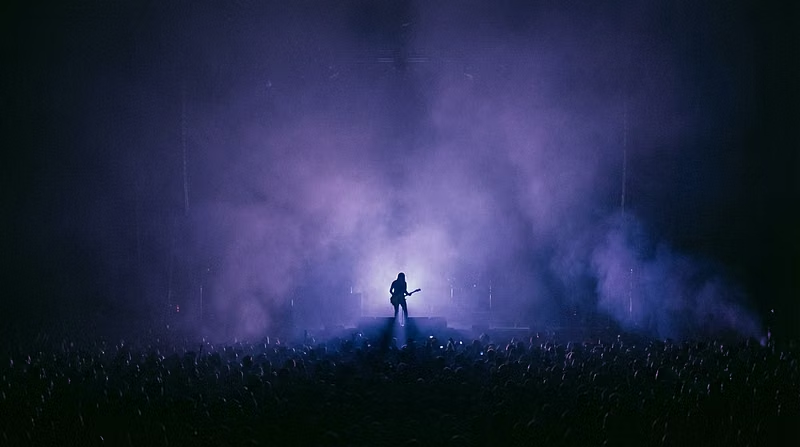
Prog metal is not primarily that. It's primarily sound as architecture. The music builds environments. It has internal logic. The compositional sophistication — the way a 15-minute piece moves through distinct emotional territories, how a polyrhythmic passage resolves, why a particular dynamic drop lands the way it does — is invisible to a camera cutting every 2.3 seconds.


So the concert film that treats prog metal like a standard rock show will always fail. It captures what's in the room without understanding why what's in the room matters. You get footage. You don't get the experience.


The Benchmark: Opeth at the Royal Albert Hall


In Live Concert at the Royal Albert Hall (2010) remains the standard against which prog metal concert films are measured, and it holds up sixteen years later because the directors understood something fundamental: the camera needs to breathe at the pace of the music, not at the pace of a music video.


The RAH film has long, uninterrupted shots. It allows silence. It follows a cymbal decay instead of cutting away from it. During "Blackwater Park"'s quieter passages, the camera just... stays. It treats the composition as the subject of the film rather than using the composition as background for a montage of sweaty musicians.


The result is that watching it is genuinely closer to listening to Opeth than to watching a rock concert documentary. That's an achievement. Most concert films make the music smaller. This one makes it feel larger than the room it was recorded in.


Steven Wilson and the Theatrical Model


Steven Wilson's live productions — Home Invasion: In Concert at the Royal Albert Hall (2018), Get All You Deserve (2012), multiple others — are the other major reference point, and they're doing something structurally different from the Opeth approach.


Wilson treats the stage as a designed environment. The visuals — the rear-screen projections, the lighting rigs, the spatial relationship between musicians — are compositional elements, not decoration. They exist in service of the music in the same way that an orchestral arrangement exists in service of a melody.


Filming that properly requires understanding that the frame includes the visual design. You can't just focus on the band. The band is inhabiting a space that was intentionally created, and the camera has to honor that space or you've fundamentally misrepresented what the show was.


When Wilson's films work — and they mostly do — it's because he maintains enough creative control that the cameras serve the show's intentions rather than imposing their own logic.


Tool's Unsolvable Problem


Tool's live show is one of the most ambitious visual productions in rock. Adam Jones' work — the rear projections, the saturation of imagery and symbol — makes a Tool concert genuinely irreducible to a filming. You can't film it because the human visual experience of being in the room, surrounded by that much carefully designed stimulus, doesn't compress into a screen frame.


Every attempt to release official Tool concert footage has either been abandoned or underwhelmed. This isn't a failure of filmmaking. It's an acknowledgment that some live experiences are, correctly, non-reproducible. The show is the thing. The document is always a reduction.


There's an argument that this is actually the right position for a band whose entire aesthetic is about the limits of mediation. But it's also genuinely frustrating if you couldn't afford the ticket.


Devin Townsend Reinvented the Category


During the pandemic-era performance drought, Devin Townsend essentially created a new format: the staged studio performance as concert film. The Casualties of Cool livestream, the various "Empath" era quarantine productions — these weren't concerts filmed in empty venues. They were something new: theatrical, high-production performances designed explicitly for the camera rather than for a room.


This matters because it decoupled the concert film from the physical limitations of touring. You don't need an audience to make a great prog metal performance document. You need intention, budget, and the understanding that the camera is a collaborator rather than a witness.


What's Coming That Deserves Proper Treatment


Three shows in the next several months that should be filmed seriously:


ArcTanGent, August 19-22 — Primus, Chelsea Wolfe, Cult of Luna & Julie Christmas performing Mariner, SikTh, Igorrr. The Mariner performance specifically is a once-in-several-years event. If that's not professionally filmed and eventually released, it's a genuine cultural loss.


Be Prog! My Friend, Barcelona, September 25-26 — Soen, The Ocean, Agent Fresco, The Dear Hunter. The Ocean performing live in their current configuration — with Lane Shi and Enrico Tiberi as the new vocal duo — is exactly the kind of thing that deserves proper documentation. Solaris is one of the year's most significant records. A properly filmed performance of material from it would be worth a lot.


ProgPower USA XXV, Atlanta, September 9-12 — The 25th anniversary show. Nevermore. The Gathering with Anneke. Roy Khan solo. This is an event show, and event shows deserve event filming.


The pattern with all three: the music is sophisticated enough that standard rock filming will fail it. The question is whether the organizers and bands care enough to do it differently.


The Actual Standard


Good prog metal concert film: serves the music's pacing, honors the visual design, understands that silence is content, and doesn't cut faster than the composition requires.


That's it. Four things. Most concert films fail on all four.


The Opeth RAH film got it right in 2010. Steven Wilson mostly gets it right. TesseracT's Portals came close. When it works, a great prog metal concert film is one of the best ways to share the genre with people who've never heard it — because you can see why it's worth paying attention to, not just hear it.


Here's hoping something from this summer's festival run gets the treatment it deserves.


---


What's the best prog metal or progressive rock concert film you've seen? And what made it work?