Recurly is a subscription management platform with 100 million+ active subscribers. It helps businesses like yours in getting, managing, and keeping subscribers.
Key takeaways
- Recurly is an enterprise-grade subscription platform built around four products: Subscriptions (billing and payment orchestration), Commerce (Shopify), Engage (lifecycle prompts) and RevRec, with its Compass AI layer running across them.
- Recurly's $1M billing volume minimum applies only to its sales-quoted All-Access tier; the self-serve Starter plan is $249/month plus 0.9% of billing volume with a 90-day free trial.
- Smaller businesses seeking simpler, more affordable subscription management should consider alternatives like Whop instead of Recurly's complex feature set.
Recurly is a subscription management platform that businesses use to handle recurring payments, payment processing, subscriber management, and more. It powers over 100 million active subscribers and reports a $16 billion annual transaction run rate.
Today, we're taking a deep dive into Recurly. Does it really live up to the hype, or are you better off using something else?
We'll run through how the platform works, its core features and pricing, and even introduce you to some alternatives.
Recurly review: Is the subscription management platform worth it?
Recurly can be worth it if your business is handling a subscriber base and needs features like multi-currency billing, analytics, and customer management systems.
With more than 100 million active subscribers and a $16 billion annual transaction run rate, Recurly has established itself as a game-changing subscription management platform.
The company has expanded well beyond core billing in recent years, launching AI-powered tools (Recurly Compass), a native Shopify subscriptions product (Recurly Commerce), and a lifecycle engagement product (Recurly Engage).
Recurly's clients emphasize its status: Paramount, Twitch, Sling TV, FabFitFun, Lucid Software, Sprout Social, NerdWallet, and more all use the platform to manage subscriptions.
Let's take a look at some of the main features of Recurly.
Recurly's features

Recurly offers a suite of tools and features designed to help you attract and retain subscribers. Using the platform, you can customize your offering to subscribers.
The main features are:
Pricing, plans and promotions
This allows you to define your customer plans, set the pricing, and tailor your promotions. You can introduce a free trial, add tiered subscription plans, and set the parameters for your promotions.
Further functionality allows you to add value, such as by offering additional paid-for products and services to ramp up your revenue.
Subscriber management

This set of features covers onboarding new subscribers and giving your customers control over their subscription, such as the ability to change plans.
In addition, Recurly lets you tailor emails to customers, so you can – for example – communicate a new offer. Here, you can also see subscribers' billing details and (if relevant) shipping info.
Payment orchestration
One of the most important functions is enabling and orchestrating payments through several processors and gateways to maximise successful payments. The platform supports 20+ payment gateways and 140+ currencies.
Some of the most popular gateways and payment methods include:
- Adyen
- Authorize.net
- Braintree
- Amazon Pay
- Apple Pay
- CardConnect
- Cybersource
- GoCardless
- Nuvei
- PayPal (including PayPal Business and credit cards)
- Stripe
- Venmo
- Worldpay
Set your preferred payment options to give your customers plenty of ways to give you money. Alternatively, you can limit the options you don't want to offer or add country-specific payment types (such as BACS for UK customers and BECS for those in Australia).
Recurring billing
Some of the features in this area are more relevant to ecommerce customers who need to add shipping fees. If you need to send out customer invoices, you can set your preferences in this section.
It also offers a level of subscription flexibility. This includes – for example – giving people the option of an annual subscription which is billed quarterly.
Want effortless subscription billing? Set up recurring payments for your SaaS in 15 minutes with Whop.
Churn management

Recurly offers a range of tools designed to limit voluntary and involuntary churn.
The measures to tackle involuntary churn include such features as automated updating of payment details, AI-powered intelligent retry logic, and enabling dunning campaigns.
You can manage voluntary churn with Recurly by offering options to pause subscriptions. This can give people a break from payments for a month or two, and Recurly reports a 337% year-over-year increase in "pause before cancel." Three out of four subscribers who pause eventually return, per the same report.
Other options include enabling discounts and promos to entice people to stay. You can also give them the ability to downgrade their subscription to a lower tier.
Recurly gives businesses insights into the reasons why a customer has chosen to leave. This can help you learn if your prices are too high or your content is not seen as value for money.
Hosted pages
With this feature, you can set options for customer checkout and payment. As well as giving your subscribers an easy and streamlined process, this gives you control over the look and branding of the pages.
You can also tailor the checkout to certain territories and regions, such as offering country-specific payment options.
Revenue recognition
This feature helps you as a business owner to comply with the applicable revenue reporting requirements under different countries' tax and accounting rules. Recurly RevRec automates ASC-606 and IFRS-15 compliance.
The service carries an additional cost on top of a Recurly plan, and it can also be bought as a standalone product
Reporting and analytics

Another critical set of tools covers the data generated by your subscribers and subscription plans.
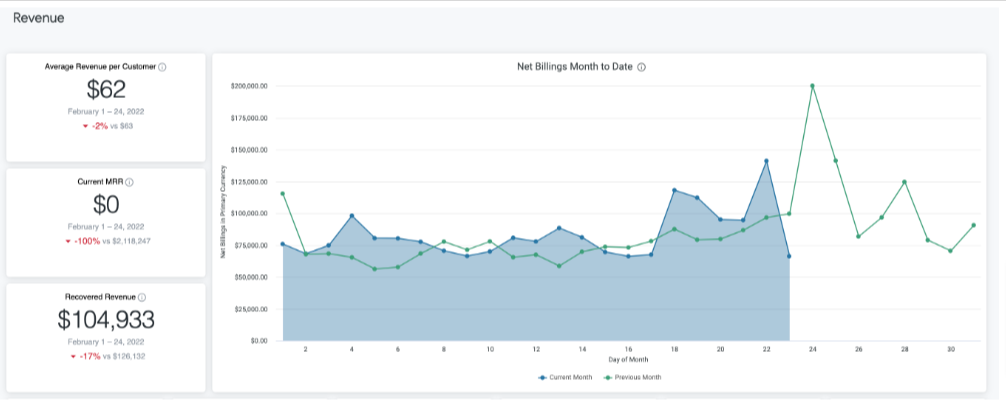
The Recurly Analytics suite (now enhanced with Recurly Compass, the platform's AI assistant), gives you a vast range of data and metrics to wade through.
You can compare your performance against your competitors, manage MRR (monthly recurring revenue) calculations, and drill down into your subscriber and payments data. With Compass, you can also use natural-language chat to surface insights, spot fraud or decline spikes, and generate API snippets to customize your subscriptions.
How do you manage subscribers using Recurly?
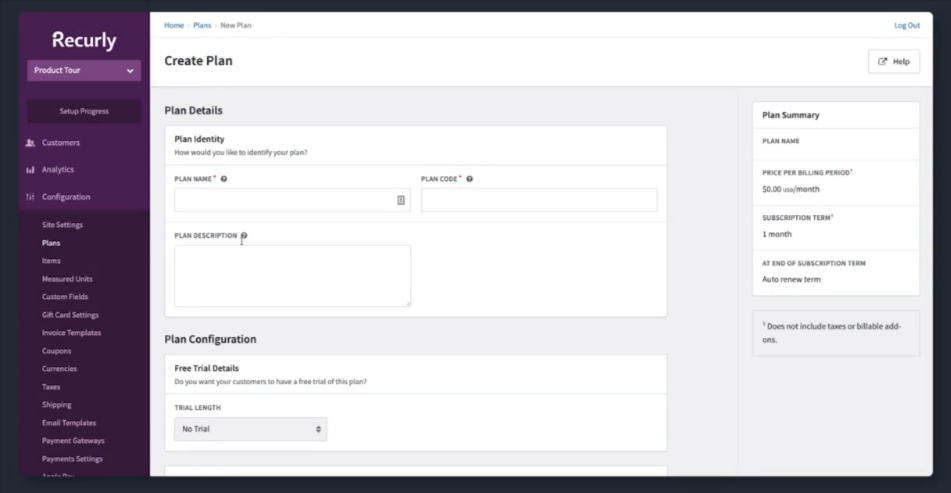
Once you’ve signed in, access to Recurly’s features is through the dashboard. From here, you can set your preferred options and create your subscriber plans.
Some of the features and options are limited for business owners on the lowest plan (more on this in the pricing section below).
Here’s what the regular Recurly dashboard looks like:
Recurly Analytics has its own separate dashboard:
How much does Recurly cost? Recurly pricing
Recurly publishes its pricing and the only tier that's self-serve is the entry tier.
| Plan | Price | Minimum |
|---|---|---|
| Starter | $249/mo + 0.9% of billing volume | None |
| All-Access | As low as <1% of billing volume, billed annually | $1M billing volume |
| All-Access for Shopify | As low as <1% of billing volume, billed annually | Not stated |
| Engage (add-on) | From $1,600/mo, billed annually | — |
| RevRec (add-on) | From $850/mo, billed annually | — |
The Starter tier includes the first $40K of billings each month and has a 90-day free trial, and you don't even have to give your credit card for it.
All-Access adds AI-powered agents and analytics, intelligent churin prevention, payments orchestration, multicurrency, and more.
The $1M billing volume is what makes the All-Access tier for enterprises rather than early startups.
Recurly advantages & disadvantages summarized
We’ve covered a lot, so here is a quick summary of the pros and cons of Recurly:
| Pros | Cons |
| Lots of features and customization options | Too many features for many users |
| 90-day free trial on Starter | $249/month + 0.9% of billings after the trial |
| Multiple customer payment options | $1M volume minimum for All-Access (add-ons billed separately) |
| Clear upgrade path from Starter to All-Access | Complex to navigate |
| Add-on features available | Overwhelming level of detail for some users |
| Granular data and analytics | |
| Manage high numbers of subscribers |
Who is Recurly best for?
Having looked at all its features and pricing model, Recurly is best for online businesses with a sizeable subscriber base.
The monthly cost gets steep once the 90-day trial ends, and most of the features we covered above is gated behind the All-Access tier and its minimum $1M billing volume.
It’s a bit like paying higher rent to live in a building with loads of amenities you never use.
Look at Recurly’s list of customers and you’ll see that it works with lots of multinationals. This is a great advertisement for its service. However, if you want an easy, less complex way to get up and running, this platform may not be your best choice.
How can a subscription management platform help you?
Subscription management platforms help you to retain your customers, while taking over some of the day-to-day admin related to running your business, such as:
Payment acceptance
This is probably the most important function these platforms serve. Once you’ve attracted a valuable subscriber, you want to be able to accept payments reliably, accurately and securely.
Subscription management platforms handle different currencies, payment options, tiered payments, promotional pricing and more for the benefit of you and your customers.
Next read: What is a payment processor and how does it work?
Subscription plans
The platforms support the creation of different paid and free plans, so you can give your subscribers a variety of sign-up options. The management includes letting people switch up or down plans, adding trials, and running other promotions.
You can also add a free option to show off your content to encourage people to sign up for a paid plan.
Analytics
Another essential feature is the ability to easily access your subscriber and payment data so that you can track your progress. It also means you can compare the different promotions you run and subscriber plans you offer to find out which gains the most traction. This all helps you to boost your subscriber value.
Subscription management platforms’ offerings vary, but the aim is the same – to help you maximize your profits while minimizing the hassle.
Next read: How to use ecommerce analytics to boost your sales
Why you should start a subscription-based business
What do you want from your online business? If the answer is regular, recurring income with unlimited growth potential, then you need to build a subscriber base.
And with Recurly's 2026 State of Subscriptions report putting overall subscription growth at 12.6%, isn't it time you took your share?
Under a subscription model, people sign up and pay (usually) each month for your products or services. This might be extra podcast episodes, articles, ebooks or anything that adds value.
Online businesses might offer a mix of free and paid content – known as the freemium model – or put all their stuff behind a paywall.
Other options include free trials or offering memberships, which are similar to subscriptions but might have more of a community vibe.
The two most important things you need to think about when building a subscriber base are:
1. Number of paying sign-ups: To have a viable business, you need to have a high number of people willing to pay for your content. This means building a large audience, as only a proportion of your free or freemium users will be converted to paying subscribers.
2. Churn rate: This is a measure of the number of people who cancel their subscriptions compared to new sign-ups. All membership and subscriber-based businesses experience an unavoidable churn.
There are two types of churn rate:
- Voluntary churn: Customers who decide to cancel their subscription and stop payment.
- Involuntary churn: Customers who unintentionally stop paying due to such factors as expired credit cards.
The key is minimizing loss by giving subscribers reasons to stick around and make it easy for them to keep their subscriptions active.
Sell more subscriptions with Whop
Ready to start making real money with a subscription-based business? You need Whop.
Whop is the end-to-end platform for building and running a business, so you can set up recurring billing, accept payments, and promote your business all from the same platform.
On the payment side, with Whop you can accept cards, digital wallets and local bank methods for recurring subscriptions.
And Whop goes beyond subscription payments. Run ads for your subscription business, track your metrics, and manage entire operation from the same dashboard. Want to run your business agentically? Use the Whop CLI to create products, manage payments, and manage subscriptions.
Start managing your subscriptions with Whop.
Recurly FAQs
Does Recurly have a free plan?
No, Recurly doesn't have a free plan. The Starter tier is $249 per month plus 0.9% of your billing volume. But you can start with a 90-day free trial.
How much does Recurly cost?
The Starter tier is $249 per month plus 0.9% of the billing volume with the first $40K of billings included each month.
The All-Access tier is quoted by sales at under 1% of the billing volume. This tier is billed annually and needs a $1M billing volume.
Which Recurly tier should I select?
While the Starter tier covers automated billing, 20+ gateways, and many more features, All-Access adds payments orchestration across multiple gateways, intelligent churn prevention, multicurrency, and more.
Most of the features that Recurly is known for is gated behind the All-Access tier.
Is Recurly a payment processor?
No, Recurly is not a payment processor. It's the billing layer that's positioned on top of a payment processor. You can connect your own gateway from the 20+ services Recurly supports. Recurly does the plans, invoices, retires, and renewals.