Starting a business is easier than ever in 2026. Follow these 10 steps – from refining your idea to marketing your launch – with real founder stories along the way.
Key takeaways
- Starting a business today requires less capital and fewer roadblocks than at any point before. The barriers that used to stop people (paperwork, funding, complex tech) have largely disappeared.
- The founders who succeed usually start by solving a problem they personally have, then figure out the rest as they go.
- Infrastructure (payments, financing, ads, entity formation) can now be handled from a single dashboard.
You can start a business in only 10 steps. It isn't the multi-year, capital-heavy push it once was.
You don't need an office, a warehouse, or six figures in savings. Aiden Arvizu started fixing up cars in his mom's driveway, now he runs VIIIZUTech, a full-time repair shop. Brennan Schlagbaum started building his business during his evenings and weekends, until his 9-5 made him go all-in.
Neither started with a business plan or a lawyer. But both started with a problem they understood, and built from there.
Here's how 10 steps takes you from idea to launch.
10 steps to starting a business
1. Refine your business idea

There's no single right way to land on a business idea. Some people build around a problem they have personally lived through. Others spot a gap by paying close attention to an industry, hobby, or community that they are a part of.
Take Josh Fabian: a competitive gamer himself, he wanted his children to have Pokémon training. And not just any trainer: he wanted them to have the best in the world. So he found the best, and hired them, only to find out that this world champion was charging only $20 an hour.
"$20 an hour. I was charging $100 an hour to coach Clash Royale and I wasn't even the best player in the world. This guy was the world champion. And he was making $30,000 a year. The skill existed. The infrastructure to actually get paid for it was almost non-existent. I knew if I didn't build something, someone else would. And they'd probably get it wrong."
- Josh Fabian, founder of Metafy
The problem was a lack of infrastructure. So Josh went ahead and built it, building himself a business in the process. To date, Metafy has paid out over $10 million to gaming coaches, all because Josh saw a problem that needed fixing.

Understand your audience
When you're solving something that you, or someone close to you, has lived through, then you already understand your target customer's frustration, budget, and decision-making.
From there, the job is to test that instinct against a broader use case. Talk to people who fit your target profile, watch how they navigate the problem, and see where your idea would work.
Analyze the competition
Understanding the customer only tells you half of the story, though. The other half is finding out who else is already trying to serve them.
Before Metafy, gamers looking to make money with their skills were using multiple platforms – links in bio, a calendar app for booking one-on-one coaching, a courses platform, a community platform – each of these taking their own cut. Josh was aware that these tools already existed, but he also knew that they didn't really solve the problem.
Before Metafy, if you were a gamer trying to make real money, you were probably using Linktree for your bio, Fiverr for coaching, Udemy for courses, and Patreon for your community.
Four different platforms, four different logins, four different fee structures. And then you've gotta string them all together. That's what the hell we're fixing.
- Josh Fabian, founder of Metafy
So look into your competitors. See what are their products like, and what business practices they follow.
Understanding the entire competitive landscape will give you an excellent idea of what you should (and shouldn’t) do, as well as highlight any unserved or underserved niches or problems within the area that you can capitalize on.
You should even consider trying your future competitors’ products and services out to see where their strengths and weaknesses lie and understand their customers' journeys.
Build your brand
Once you've found your niche, branding comes next. You know what's underserved – now you build the brand to show that you're the one filling it.
Coral Mujaes, the mastermind behind one of Latin America's largest online education businesses, says:
Most people think people buy courses, coaching, or information. They don't. People buy identities. People want to see someone who embodies the result they're pursuing. They want to look at your life and think: if I follow this person, maybe I can become that version of myself too. That's why consistency matters so much. Not because it helps the algorithm. Because trust compounds.
- Coral Mujaes, mindset and business coach

Think about it. You can be in a new city, stood outside two burger joints that both sell the exact same products, at the exact same price. But you already know one brand, and the other is unfamiliar to you. You're going with the one you know.
Brands with a clear sense of identity are the ones who win. Weak branding means paying more, later, to explain what should already be obvious.
Want something more turn-key? Consider franchising
If building all of this from zero feels like a lot, then franchising is the shortcut. You can license someone else's brand, business model, and playbook – meaning your job narrows down to simply funding and location. Don't neglect market research here either – before committing to a spot check out who else is operating nearby, and figure out which brand would make a great fit for the neighborhood.
2. Research the market

Talking to customers and sizing up competitors, like in the previous step, is a part of market research – but it's not the whole picture.
Get your market research wrong and it won't matter how good your idea is. Roughly one in five small businesses fail within their first year (according to the Federal Reserve), and half don't make it past five. They're not all bad ideas, but rather they're good ideas built on assumptions instead of research.
Here's what market research looks like in practice, using an ice cream shop example.
Setting up an ice cream shop next to a park seems like a fairly safe bet. People like ice cream – children especially – and the location has foot traffic. But does that park get visited outside of a few summer weekends?
Do the kids who play there get pocket money, or are their parents actually willing to spend on ice cream regularly, rather than as a rare treat? Are there any other ice cream places nearby, that people already visit habitually?
The SBA (Small Business Administration) breaks down market research into a few concrete questions that you should ask before building any business:
- Demand: is there real demand for this now, and will it hold up over time, or is it a trend that's already peaking?
- Market: who is your customer, and what would actually get them to choose you?
- Economic conditions: how sensitive is your target market to a downturn, interest rates, or economic shifts?
- Location: where are your customers – physically or online – and how will they find you?
- Saturation: how many alternatives does your customer already have, and how easy is it for them to switch?
- Willingness to pay: what will people pay, and does that number leave you with a profitable business?
Answering these questions takes two kinds of research working together. Secondary research that pulls from existing data, like census data, industry reports, competitor pricing, and web analytics.
Primary research, which means a) you going directly to potential customers yourself and asking questions through interview and surveys, b) if starting a physical business, scouting the location you are considering every day, at every hour, not just on a sunny saturday.
Neither one alone is enough. Secondary data tells you the size of the opportunity, primary research tells you whether you have a shot at capturing it.
3. Create a business plan
Not every business needs an in-depth plan on day one. Brennan Schlagbaum didn't write one before he started Budgetdog – he simply started an Instagram account named after his dog.
But at some point, especially if you want investors or a loan, you need to put the business down on paper. A business plan is that roadmap: what you're building, how you'll fund it, and who's going to run it.
Need help? The SBA offers two free templates worth looking into, because they're built for different situations. The traditional format is the one most people think of, with an executive summary, company description, market analysis, and financial projections. These typically run several pages.
The second is a lean, startup format that is a lighter one-page version, built for people who want to move fast and expect their plan to change quickly as they learn.
If you're going the traditional route, here are the most important sections:
Executive summary
This is the two-minute version of your entire plan: the problem you're solving, your business idea, the milestones you're aiming for, and a preview of everything else in the document, including your target customer profile and team makeup. It's the first thing the reader sees, but usually the last thing you'll write.
Company description
Your branding from step 1 belongs here. This is also your cue to lock in a domain name and claim it before you finalize your branding.
Mission and goal statement
Your company’s vision, mission, and goals also need to go into your business plan. All successful companies do this well. It’s worth searching for the vision and mission statements of some well-known companies so you can take inspiration for your own.
Company structure
We’ll look at how to set up a business structure later on, but once you’ve planned out a structure you’ll want to detail it in your business plan. That way, readers can understand your team makeup and organizational structure at a glance.
Competitor and market analysis
All that research from step 2 belongs in here. If this section is a little thin, a reader will assume that the research never happened. Add a background summary too, covering trends that could shift your industry moving forward.
Product or service details
Go beyond describing what you sell. Clearly outline your unique selling proposition (USP) to help readers understand how your product is different from what else is in the market and what niche it’s going to address.
Business model
The model of your business should be quite clear after the previous sections, but you should revisit it briefly and then add some information on how exactly you’re planning to scale, or serve more and more customers as demand rises while keeping expenses down.
Marketing plan
This covers a big share of the time and money you will spend, so it earns its very own section. A few businesses can skip heavy marketing – like consultants solving a niche problem with connections already in place – but most need a real plan.
Financial plan
This is the section that investors and lenders scrutinize the hardest. At minimum, include a projected income statement, balance sheet, and cash flow statement going out to five years if possible.
Then, you can gather all this information and send it to the pitch deck design agency like Whitepage that can make an eye-catching deck of your business for potential investors and therefore get funds.
It’s also wise to consider an exit strategy at this stage. While you wouldn’t include it in your business plan, it’s a good idea to spend a little time considering what you might do in case you decide that you’ve had enough for whatever reason.
4. Get your finances in order

Some businesses can be started and run on a shoestring budget, but that’s not always the case.
Consider a traditional business model selling a physical product. Assuming that you’re coming in with knowledge and expertise, you’ll still need a location to run your business, equipment to manufacture your products, space to store raw materials as well as finished goods, and money to spend on advertising the fact that you’ve got stuff for sale.
All of this costs money, and starting a business generally requires capital. Many entrepreneurs save their own money to start a business, others borrow, some sell an initial stake of their company to wealthy investors, and plenty seek out business grants.
Today, there are other options on offer too such as crowdfunding. Aiden Arvizu did this when a deer totaled his car and he had no insurance, and no money to fix it. He took to TikTok, figuring that if everyone who watched it Venmo'd him a dollar, he'd have enough to rebuild his car. He rebuilt his car, and, built a business.
But not every funding problem gets solved by going viral.
It’s very likely that you’ll need a certain amount of money to get started and then tide you through until your business becomes self-sustaining. That’s where a break-even analysis comes in, showing you how much revenue you need in order to break even.
Here’s how you calculate your break-even point:
Step 1: Calculate your fixed costs. These are going to be costs that don’t change, such as the salaries of full-time employees or monthly rent you pay for your manufacturing facility.
Step 2: Calculate variable costs. These depend on how much you’re going to be producing, so you’re looking at things like the power consumed by machines or cost of raw materials.
Step 3: Now, take your fixed costs, and divide them by the amount you earn per unit of product less variable costs. So, the formula looks like this:
Break-even = Total Fixed Costs / (Price per unit - Variable Costs per unit)
What this formula gives you is the number of units of your product you need to sell in order to break even.
This should now tie into your marketing projections and market research, and you should be able to figure out how many sales you make at a given price in order to break even, and whether that’s realistic.
Here's an example: let’s say that you’re running a hot dog stand, renting a small location at the corner of a lot.
Rent’s $1000, you sell a hot dog for $5, and ingredients cost $3.
To break even, you’ll need to sell $1000/($5-$3) or 500 hot dogs.
Sell more, and you’re in profit.
The higher you can price your products, the fewer you need to sell in order to break even. But, using that same example, hiking the price of your hot dogs up to $7 gives a break even point of 250 hot dogs—but this comes at the risk of pricing many customers out.
And bear in mind the limitations of a break-even analysis— primarily, the fact that it assumes that fixed and variable costs stay the same.
This isn’t true. Variable costs can change quickly, especially in a high-inflation environment, and fixed costs can also go up via rent alterations, tax regime changes, and giving your employees raises.
Beyond break-even and funding, it’s also important to control your expenses right from the start, since every bit of cash saved early on gives you a few days, weeks, or even months in terms of stretching your starting capital out.
5. Decide on a business structure
Another extremely important consideration as you start your business is what sort of legal structure or entity you want it to be. Some structures remove personal liability entirely, meaning your own finances stay untouched if something goes badly wrong with the business. Others don't. That's usually the deciding factor.
Where you're based often affects this decision, too. The five structures below are common in most countries, but the exact procedures and benefits vary.
- Sole proprietorship: If you just start your business up without doing any paperwork or registration, such as by starting a YouTube channel and getting platform payments for example, you’re essentially a sole proprietorship.
The advantage here is that you don’t need to do very much in terms of filing paperwork or consulting lawyers, but you are fully liable for any sort of debts your business may incur.
This structure is fine for a side hustle, but once it starts to pull in some cash, consider switching to another structure. - Partnership: Partnerships are like sole proprietorships, except that the personal liability is shared between yourself and whoever else you decide to partner up with—usually one other person, or two.
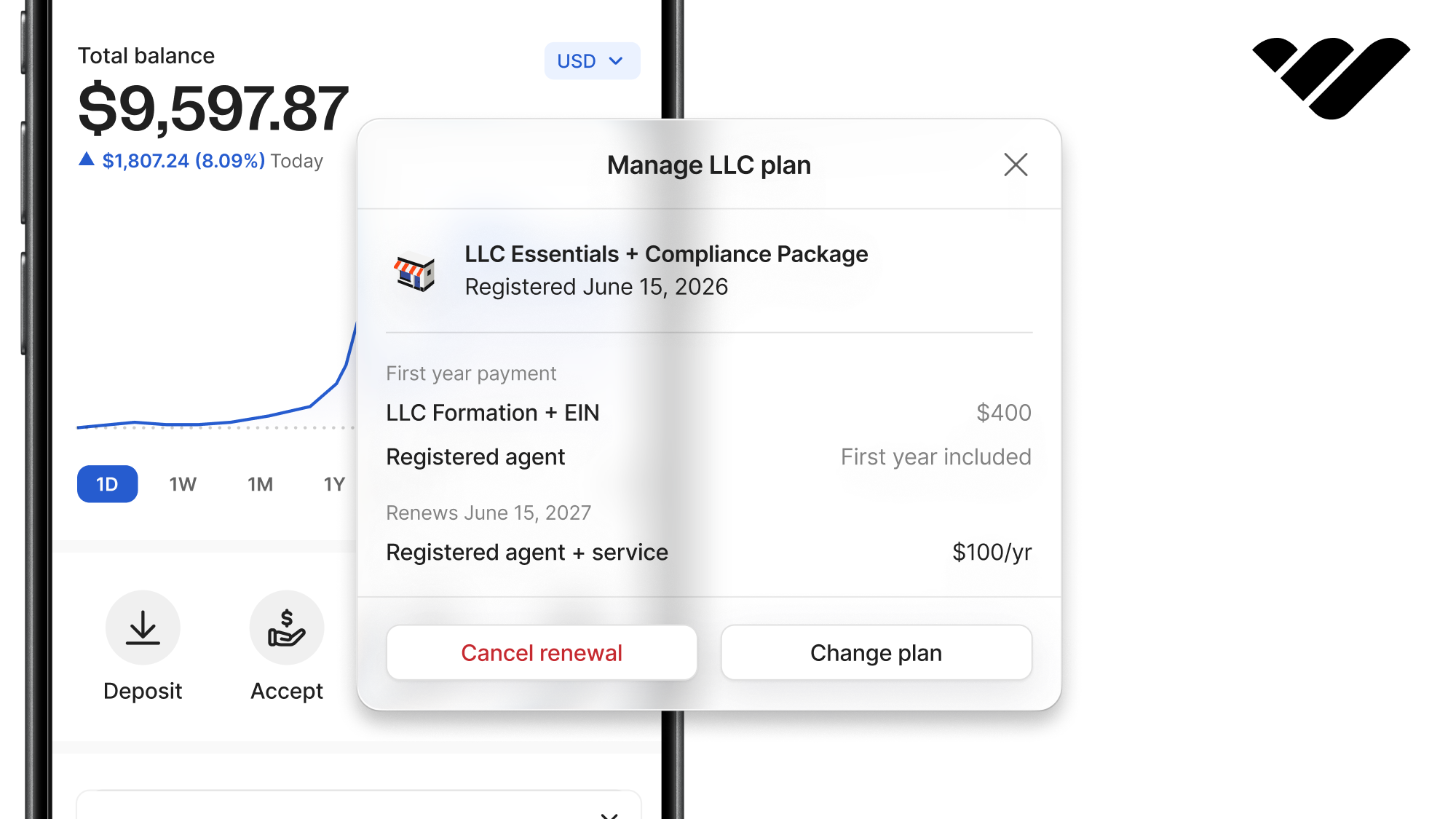
- Limited liability company (LLC): This is a great option for businesses since it grants a lot of legal protection to yourself as the owner, but with the freedom and flexibility to operate the business however you want to just like a sole proprietorship. Traditionally, forming one meant filing articles or organization, paying state fees, appointing a registered agent, and applying for an EIN through the IRS. Now, with Whop, you can register an LLC directly through Whop.
- Limited liability partnership (LLP): This one is to a partnership what the LLC is to a sole prop—it’s got liability protection for multiple owners rather than just the one. There’s actually no limit to the number of partners an LLP can have, but all of them are required to actively take part in the business, and they’re also personally liable in the case of malpractice claims against the business. Law firms usually use this structure.
- Corporation: This structure offers the same sort of liability protection for owners as an LLC does, and they can have an unlimited number of shareholders. However, taxation can be an issue, and you’ll need to be careful here—if you’re looking to pick up venture funding you’re going to be taxed as a C-corp, but if not you’re probably looking at S-corp status which offers pass-through taxation.
6. Register your business
Once you've settled on a structure, it's time to make it official. The exact process depends heavily on where you're based, so here's the general shape of it.
If you're forming an LLC in the US, this step is largely solved already. Whop handles the state filing and EIN application for you as part of registering. For sole proprietorships, partnerships and corporations, that process runs through your state directly.
Your starting point is to check with whatever entity is in charge of commerce in your jurisdiction, so it might be a chamber of commerce or your state’s business agency. You’ll typically need to appoint a registered business agent or representative to accept legal documents on your business’ behalf.
Once your filing fee is paid and everything clears, you'll get a certificate from the state that lets you apply for the licenses and permits you need, plus a tax identification number. Hold onto the certificate, you'll need it to open a business bank account, too.
From there, US-based businesses need an Employer Identification Number (EIN). This is a hard requirement unless you’re a sole proprietorship with no employees.
The last major piece of red tape to take care of is to consult your local government offices as well as your legal representative to see what local, state, and federal permits and licenses you need to operate your business. This varies a lot of industry – a food truck and a consulting business will run into completely different requirements.
Before completing your registration, keep your branding and business name in mind. You’ll have to register your company using its name, but your branding can actually differ from the legal name of your business. This is called DBA or “doing business as”. So, your business could be something like Gary Jones Enterprises LLC, doing business as “Gary’s Gardens”.
7. Start building out your team
Plenty of entrepreneurs run the entire business themselves – at least at first. Solo is the norm. with SBA data putting small businesses employing zero people at 82.3% of small businesses in the US, relying on software to handle the functions of accountants and marketers.
Other businesses start with a full team from day one, especially larger businesses. Branson Packard and Wil Geller, the founders of FoodFluence, met as kids playing little league together and stayed close enough through college to eventually build a platform together.

And Joe and Cole Tenney, the brothers behind Woobie, both served in the Navy before creating their business together.

If you're building alongside others, get clear on how you'll divide responsibilities and ownership (and put it in writing where you can). Vague agreements tend to surface as big problems later, usually at the worst possible time.
And if the business is your idea but you need other people to get it off the ground, start by being honest about where you fall short. Once you know what you're not good at, or dont' have time for, then you can find the right person to fill those gaps.
8. Set up your business tools
Every business needs help with the backend. Thanks to the internet, most of that can now be handled through software rather than hired out individually.
Payments are the clearest example. We gave the example of a hot dog stand previously. That sort of business works fine with cash, but a simple P2P online payment system – like Tap to pay – could give you even more sales from people who prefer going cashless or just aren’t carrying spare change on that given day.
If you're running a service-based businesses, then you'll likely need invoicing. Daniel Petrovskiy, who runs Pinnacle NW Kitchen & Bath, sends invoices directly from Whop with a due date and payment options built in, uses checkout links for smaller jobs and change orders, and offers financing through providers like Klarna and Afterpay.

For businesses that might be a little more complex or nuanced, systems like embedded checkout or payouts may be needed.
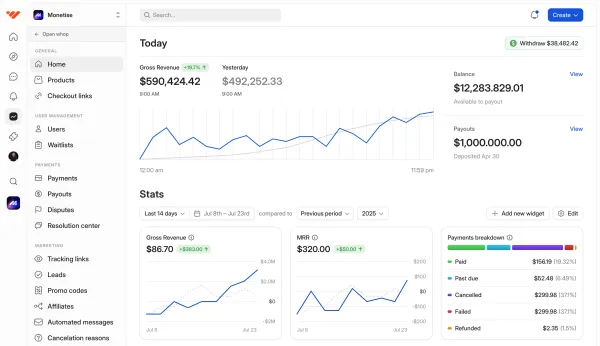
Running a business used to mean finding multiple vendors to build your point of sale system, separate financing provider, card reader, and more. Now, it can all run through one dash, with Whop. One system that covers online checkout, invoicing, payments, payouts, access to financing – for all business models.
Beyond payments, you'll also want to look for vendors to take care of functions like accounting, human resources, order processing, and even fulfillment. Tax is a good example of another thing that doesn't need its own subscription or vendor. Whop Tax Service handles sales tax and VAT from the same dashboard as payments, letting sellers choose how hands-off they want to be.
9. Implement your business systems

With your tools and vendors in place, the back end of the business is mostly handled. What's left is the front end, i.e the processes that make the business run day to day.
What that looks like depends on what you're building. Gary’s Gardens will probably entail a lot of different things than a hot dog stand would, and they’re both a world removed from something like selling AI chatbots or creating a SaaS platform.
If you’re running a traditional manufacturing business, you’ll need to design a layout for your production processes, acquire and install machinery, sign on logistics partners, and get your fulfillment systems in place.
With ecommerce, you’re probably focused totally on the fulfillment side of things. You’ll have to sign on with a production company to get the manufacturing or assembly done for you.
With internet businesses, the running is arguably a lot easier, especially now that a lot of manual admin work behind the scenes can be automated rather than clicked through by hand. According to the SBA, 50% of US small businesses are using AI in some part of their operations, mostly for the repetitive work like writing, planning, and reporting.
When you power your business with Whop, the Whop CLI takes everything you would normally do by clicking around the Whop dashboard (creating products, setting pricing, running ads, moving money) and turns it into commands that you can type into a terminal instead.
You can automate your entire business, without needing a coding background. AI agents like Claude or Cursor can run and read the commands themselves, meaning you just describe what you want in plain language and let the agent handle the rest.
Ryan Ouyang, Whop's Head of Platform API, puts it directly: "A business owner shouldn't need to know what an API is to say 'set up the pricing on my Whop website' or 'pull my sales for the week and optimize my ads.' The CLI closes that gap. Once the intent is there, the agent handles the commands to build exactly what you need."
10. Start marketing
Even before launching your business, you’ll want to start setting the wheels in motion on the marketing front.
Every industry does this—think movie trailers and the many flicks that you first learned of from hearing the voice of someone like Don LaFontaine (In a World…) or Jon Bailey.
By promoting your brand and products prior to launch, you can give yourself a leg up in terms of getting product off the shelves. Starting a business and seeing your revenue sit at $0 for hours or even days after launch just wouldn’t do. You want people talking about your brand and ready to buy your stuff even before you hit the market.
Today, the most economical and arguably also most effective way to market your brand and your products is via social media. There are tons of platforms to choose from, and you can hand-pick which ones you use based on your target audience.
As an example, you might use Facebook to reach older folks, or Reddit to find niche markets. The effect can be bigger than you'd expect, even outside of obvious advertising. FoodFluence connects local restaurants with food creators, and says that 82% of people have tried a new restaurant simply because they saw it on their social feed.
Organic reach only gets you so far, though, and paid social doesn't have to mean learning platform algorithms on top of everything else you're already doing.
Whop Ads gives sellers access to agency-grade Meta ad accounts, first-party attribution through Whop's own pixel, and lookalike audiences built from real buyer data across the platform – all from the same platform you're already using for payments (and yes, you can manage this through the CLI, too).
Beyond socials, you'll also want to invest in other marketing efforts, like SEO, email marketing, and if relevant to your business model, in-person advertising.
What's next? Growing your business after launch
Launching a business is not the finish line. In fact, the work is just getting started. Breaking even takes time, and from there, scaling is the next big step.
Because building a business is easier than ever, you're also doing this alongside more people than ever before. New business applications have stayed well above pre-2020 levels, with around 524,000 filed in a single month this year (United States census data). These are largely one-person operations rather than teams. So being a solo founder isn't a niche path anymore – it's the norm.
How you scale from here depends on what you've built, but there are a few things that are the same across any business.
- The first is removing yourself as the bottleneck. If your business runs on personal time (like client calls, customer orders, personal delivery) then growth is capped by hours in the day. Find a way to serve a room full of people instead of one at a time. If you're a consultant, open up group spots. If you're a coach, do the same. If you're a baker, hire an assistant. Outsource and delegate wherever you can.
- The second is automating what doesn't need a human at all. Payments, invoicing, follow ups, tax filing – there's no reason that this should be eating up your time once the business is on its feet. Save yourself hours a week by automating the nitty-gritty work.
- The third? Expanding what you're already good at rather than starting over. If you're a tradesperson, start franchising. If you're a coach, sell downloadable courses. If you're a baker, sell a cookbook. Grow revenue from the audience you already have, by creating something once and selling it over and over again.
Turn your business idea into reality with Whop
Starting a business is no small feat, but it doesn’t have to be overwhelming. You now have the steps laid out, but turning that vision into something profitable requires the right tools and support.
That's where Whop comes in. Whop is the end-to-end platform for launching and building a business. You can seamlessly manage sales, payments, ads, cards, and more, from one dashboard.
FAQs
How to start a small business with no money?
Business owners can get funding from a variety of sources such as grants, angel investors, venture capitalists, crowdfunding, or even bank loans. Make sure you check with your local business authority to see what funding options may be available to you.
How much does it cost to start a business?
It can cost anywhere from nothing to millions of dollars to start a business, depending on what the nature and scope of it is. A shipbuilding company might set you back a whole lot of zeros compared to, say, selling handmade pottery from your garage or, even cheaper, selling internet products.
How to start a cleaning business?
To start a cleaning business, it’s often advisable to set up a LLC or corporation thanks to the sensitivity and liability aspect of the business — people will be letting you or your team into their homes or businesses, after all. Then, choose your niche, develop your pricing plans, and make sure you budget for things like cleaning gear and transport.
What’s the most profitable business to start?
Any business can be highly profitable if you do it well and secure some clear competitive or even absolute advantages for yourself. That being said, as a general rule, businesses that focus on premium products tend to be more profitable especially given that you’ll need to grow your business to a certain point in order to profit from quantity.